

Consistent practice is one of the most effective ways for Primary 5 students to strengthen their Maths skills and prepare for more complex problem-solving in Primary 6.
While many students can handle straightforward textbook exercises, they often struggle when questions involve multiple concepts, unfamiliar wording, or several steps of working. These are the situations where regular practice becomes especially valuable.
To help students build confidence and sharpen their problem-solving skills, we have compiled a set of P5 Maths practice questions covering a range of commonly tested topics, including fractions, percentages, volume, measurements, and multi-step word problems.
What These Practice Math Questions Are Testing

These questions are designed to assess more than calculation skills alone. They target several key areas that Primary 5 students need to develop before moving on to more advanced Maths topics.
Multi-Step Problem Solving
Many exam questions require students to connect several pieces of information before arriving at a solution. Questions involving volume, fractions, percentages, and money often fall into this category.
Unit Conversion
Students frequently lose marks in their exam papers because they overlook unit conversions, such as converting litres to millilitres or metres to centimetres before performing calculations.
Logical Reasoning
Some questions require students to identify relationships between quantities and work backwards from the information provided.
Mathematical Accuracy
Even when students understand the correct method, careless mistakes such as copying figures incorrectly, missing units, or misreading the question can still cost valuable marks.
A Simple Framework for Tackling Maths Problems
When approaching any unfamiliar question, encourage your child to follow these four steps before attempting a solution:
- Identify the information given.
- Determine what the question is asking for.
- Decide which concepts or operations are needed.
- Check whether the final answer is reasonable and includes the correct units.
Following a consistent process helps students develop confidence and avoid rushing into calculations before understanding the problem.
Primary 5 Maths Questions for Practice
Question 1
Gina had 3.06l of water in a jug. She poured the water into identical cups with some water left in the jug. Each cup had a capacity of 280ml.
(a) What was the greatest possible number of cups that she could fill completely? [2m]
(b) What was the amount of water left in the jug? [2m]
Answer
(a) 10 cups
We know that:
- 1 jug = 3.06l = 3060ml
- Capacity of 1 cup = 280ml
So, find out how many full 280ml cups can be made from 3060ml.
3060ml ÷ 280ml = 10 cups
(b) 260ml
Figure out how many ml are needed for 10 filled cups, and calculate accordingly to find the remainder.
280ml x 10 = 2800ml
3060ml – 2800ml = 260ml
Question 2
Siti had a total of 20 pieces of two-dollar and five-dollar notes.
Peter had 13 pieces of two-dollar notes and 10 pieces of five-dollar notes.
Peter had $12 more than Siti.
(a) What was the amount of money Peter had? [2m]
(b) How many two-dollar notes did Siti have? [2m]
Answer
(a) $76
Calculate how much money Peter has in total.
13 x $2 = $26
10 x $5 = $50
$26 + $50 = $76
(b) 12 two-dollar notes
First, determine how much money Siti has in total. Since Peter has $12 more, we can subtract that from his own total.
$76 – $12 = $64
Next, find out how many $2 notes she has.
Assume that all 20 notes were $5 notes:
20 x $5 = $100
However, Siti has $64 and not $100.
$100 – $64 = $36
The $36 here represents the extra value. The next step is to determine by how much we are overcounting.
5 – 2 = 3
$36 ÷ 3 = 12
Siti has 12 two-dollar notes.
Question 3
The total mass of a box with 120 similar rulers is 1.9kg. The mass of the same box with 150 similar pencils is 6.7kg. The mass of a pencil is 4 times the mass of a ruler. What is the mass of the empty box in kg? [3m]
Answer
0.7kg
We know that:
- Box + 120 rulers = 1.9kg
- Box + 150 pencils = 6.7kg
- Weight of 1 pencil = 4 rulers
First, we should convert everything to a ‘ruler’ to make comparisons.
150 pencils x 4 = 600
Since 150 pencils equals 600 ruler equivalents, we can compare and determine the difference.
600 ‘rulers’ – 120 ruler = 480 extra ‘rulers’
Next, find the mass of 1 ruler.
6.7kg – 1.9kg = 4.8kg
4.8kg ÷ 480 rulers = 0.01kg per ruler
Now, we can calculate the mass of an empty box.
0.01kg x 120 ruler = 1.2kg
1.9kg (box with rulers) – 1.2kg (just the rulers) = 0.7kg
Question 4
Hallmah bought 174m of cloth to make some tote bags and blankets for a charity event. She used 205cm of cloth to make a blanket. She made 48 such blankets and 40 such tote bags with the remaining cloth. How much more cloth was used to make each blanket than each tote bag? [4m]
Answer
16cm
The first step here is to convert the total cloth from m to cm.
174m x 100 = 17400cm
She made 48 blankets in total, each using 205cm of cloth. With this, find out the length of the remainder.
48 blankets x 205cm = 9840cm
17400cm – 9840cm = 7560cm
Now, we can find out how much cloth is used to make one tote bag.
7560cm ÷ 40 = 189cm
205cm (1 blanket) – 189cm (1 tote bag) = 16cm more cloth is used for each blanket
Question 5
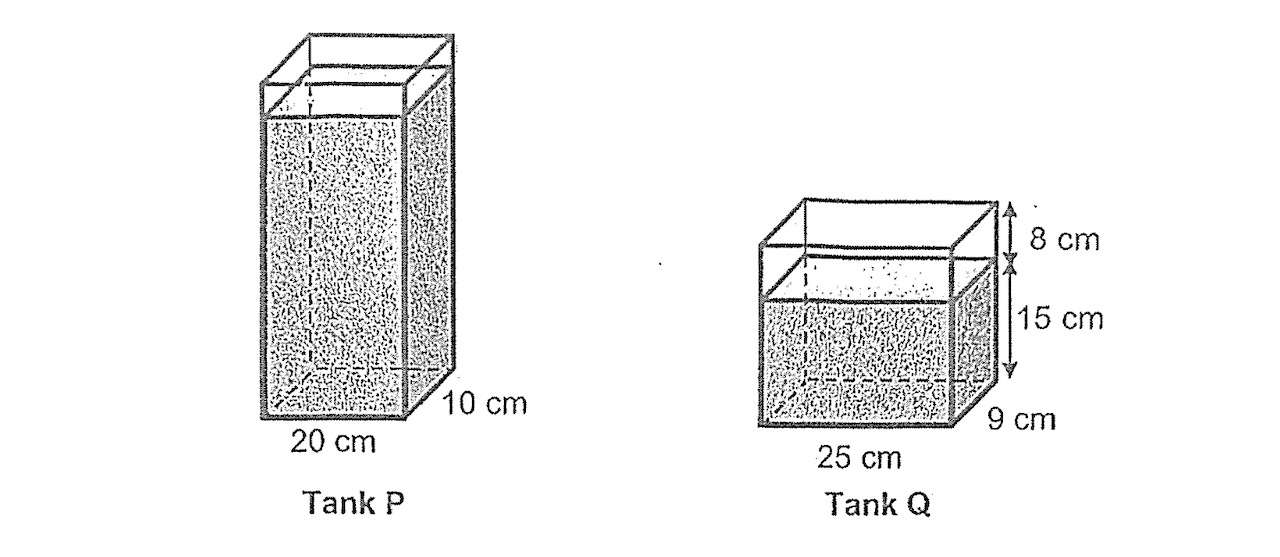
Two rectangular tanks, P and Q, had some water at first.
Hatti poured ¼ of the water from Tank P into Tank Q to fill it to the brim, without overflowing.
(a) How much water was there left in Tank P? [2m]
Hatti then poured some water back from Tank Q into Tank P to fill it to the brim, without overflowing. There was 2775cm3 of water left in Tank Q.
(b) What is the capacity of Tank P? Give your answer in litres. [3m]
Answer
(a) 5400ml
Let’s find out how much water has been transferred from Tank P to Tank Q.
¼ of water in Tank P = 25cm x 9cm x 8cm = 1800cm3
¾ of water in Tank P = 1800cm3 x 3 = 5400ml
(b) 7.8l
First, calculate the total volume of Tank Q.
Vol of Tank Q = 25cm x 9cm x 23cm = 5175cm3
Water poured to Tank P = 5175cm3 – 2775cm3 = 2400cm3
From here, we can determine the capacity of Tank P.
Capacity of Tank P = 5400cm3 + 2400cm3 = 7800cm3 = 7800ml = 7.8l
Question 6
Mr. Chandran bought a television that cost $1320 before a discount of 30%.
(a) Find the amount of discount given for the television. [1m]
(b) Mr. Chandran $1722 for a laptop. The total discount for the television and the laptop was $642. What was the percentage of discount given for the laptop? [3m]
Answer
(a) $396
We know that:
- 100% = %1320
- 30% = ?
With this, find the amount of the discount.
$1320 x 30%
= $1320 x 0.3
= $396
(b) 12.5%
Start by determining the discount for the laptop.
Laptop discount = $642 – $396 = $246
To get the percentage discount, we need to calculate the change over the original.
% discount = change/original
= $246/($246+$1722)
= $246/$1968
= 12.5%
Question 7
At a carnival, the admission ticket prices for a child and an adult are shown in the table below.
| Type | Price per ticket |
|---|---|
| Child | $10 |
| Adult | $25 |
The number of children was thrice the number of women at a carnival. The number of women was twice the number of men. There were 210 children at the carnival.
How much more was collected from the sale of adult tickets compared to child tickets? [4m]
Answer
$525
Start by determining how many children, men and women were in attendance.
210 children ÷ 3 = 70 women
70 women ÷ 2 = 35 men
70 women + 35 men = 105 adults
Now, let’s calculate the ticket sales.
Child tickets = 210 x $10 = $2100
Adult tickets = 105 x $25 = $2625
$2625 – $2100 = $525
Question 8
Leon worked 6⅕h daily from Monday to Friday.
He worked 4⅔h on Saturday. He did not work on Sunday.
How many weeks must he work to have worked 535 hours? [3m]
Answer
15 Weeks
Step 1: Convert to improper fractions
6⅕ = 31/5 hours per day (Monday–Friday)
Total for 5 days:
31/5 × 5 = 31 hours
Step 2: Add Saturday hours
4⅔ = 14/3 hours
Weekly total:
31 + 14/3
= 93/3 + 14/3
= 107/3 hours per week
Step 3: Find number of weeks
535 ÷ 107/3
= 535 × 3/107
= 1605/107
= 15 weeks
Final Answer: 15 weeks
Question 9
At first, Mei Ling had 200 blue markers and some red markers. After she gave away 60 blue markers and ⅔ of the red markers, she had 180 markers left. How many markers did she have at first?
Answer
320
First, determine the amount of remaining blue markers.
200 blue markers – 60 blue markers = 140 blue markers
Now, we can find the number of red markers left since Mei Ling has 180 markers in total.
180 markers – 140 blue markers = 40 red markers
With this, we can calculate the total number of markers she had at first.
Since Mei Ling gave away ⅔ of the red markers, the remaining 40 red markers represent ⅓ of the original quantity.
Therefore:
40 red markers x 3 = 120 red markers
200 blue markers + 120 red markers = 320 markers
Question 10
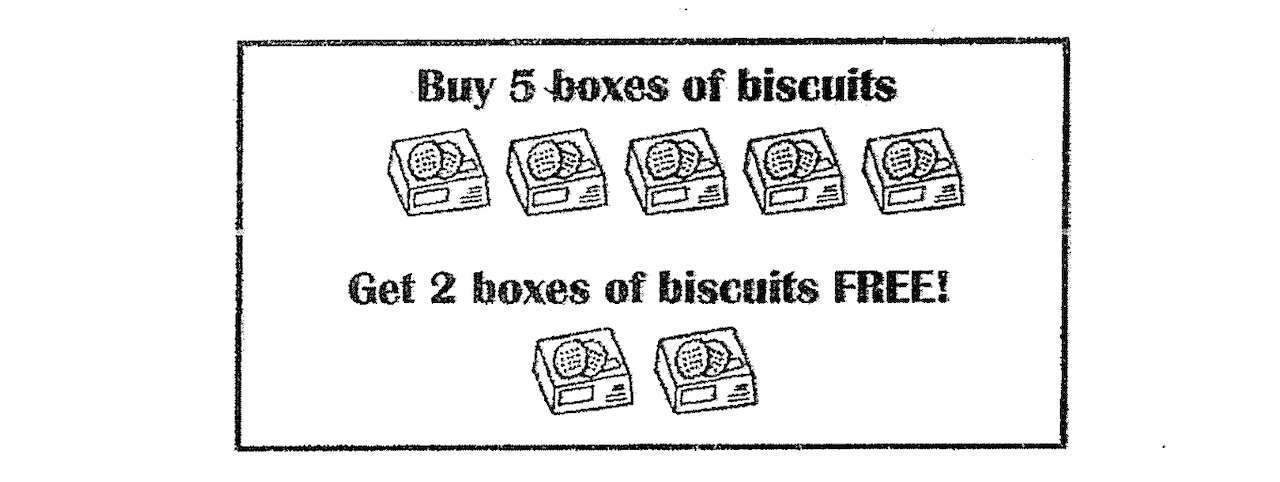
A box of biscuits is sold at $5.50. For every 5 boxes of biscuits bought, 2 boxes of biscuits are given free.
Screenshot
(a) Nadiah bought some boxes of biscuits and paid a total of $126.50. How many boxes of biscuits did she have? [3m]
(b) In every box of biscuits, there are 10 pieces of biscuits. Daryl needs to get 485 pieces of biscuits. What is the least amount of money he has to pay? [2m]
Answer
(a) 31 boxes
Start by calculating how much 5 boxes will cost.
5 box x $5.50 = $27.50
Since Nadiah paid $126.50, we need to determine how many sets she has.
$126.50 ÷ $27.50 = 4 sets
Next, calculate how much 4 sets of boxes cost.
4 sets x $27.50 = $110
$126.50 – $110 = $16.50 remaining balance
Find out how many boxes Nadiah can get with the remaining balance.
$16.50 ÷ $5.50 = 3 boxes
Now, we can finally calculate the total number of boxes Nadiah has.
4 set x 7 boxes = 28 boxes
28 boxes + 3 boxes = 31 boxes
(b) $192.50
Each box has 10 biscuits. We first need to calculate how many boxes Daryl needs to buy to get 485 biscuits.
485 ÷ 10 = 48.5 = 49 boxes needed
Every 5 purchased boxes give 2 additional boxes free, meaning each complete promotion set provides 7 boxes in total.
Since Daryl requires 49 boxes:
49 ÷ 7 = 7 promotion sets
Daryl can get exactly 49 boxes by buying 7 sets. We can then calculate the total price he needs to pay.
7 set x $27.50 = $192.50
When Practice Alone is Not Enough

When all is said and done, practising at home has its own limits.
Practice questions are useful precisely because they reveal where your child may struggle, and identifying weak areas is only the first step.
Without access to proper guidance, students may continue to repeat the same mistakes without fully understanding why. A common assumption is that simply doing more practice will automatically lead to improvement, but this is not always the case.
Structured support, such as tuition classes, plays an invaluable role in bridging that gap.
With the right guidance, your child can learn effective methods to strengthen weak areas and ultimately build a deeper understanding of each concept.
Considering a tutor? Read our article on Signs Your Child Needs a Tutor to help with your decision-making process!
Develop Confident Problem Solvers with The Nuggets Academy!
At the end of the day, it is the quality of practice, not just the quantity, that makes the real difference in PSLE Maths preparation.
The Nuggets Academy helps provide this kind of structured support, turning practice into meaningful learning that leads to real improvement.
As part of our commitment as a tuition centre trusted by parents and families across Singapore, we turn struggling students into confident individuals with improved grades.
We understand the value of practising questions together, breaking down each step so students can see how numbers and concepts connect in each case, rather than treating problems as isolated exercises in books.
Ready to see an improvement in your child’s math skills? Contact us to start your journey today!