


Think about the last time you glanced at a clock and wondered, “Can I still make it?”
In that split second, your mind weighed up how far you had to go, how long you had and how quickly you would need to move. That is speed, distance and time at work, and it is a relationship you already understand better than you think.
So, how do you calculate speed, distance and time on paper? This guide turns that instinct into clear, repeatable steps so students can follow along independently, while parents can use each step as a teaching prompt.
Understand Speed, Distance, and Time
What each value means
Every speed question is built from three values.
Distance is the total length of the path travelled, or how far an object has moved along its route. It is measured in units such as centimetres, metres, kilometres or miles.
Time is how long that journey takes, counted in seconds, minutes or hours.
Speed is the rate at which distance is covered, written as m/s, km/h or mph. Each measurement needs its unit, so never write a bare number as your answer.
Imagine two students setting off at the same time and walking 1 km to the same bus stop. The one who arrives first has the higher average speed, assuming both travel the same distance.
Once you can describe a situation in terms of distance, speed and time, the calculations that follow become much easier to organise.
Speed and velocity are not the same
Speed tells you how fast something is moving. Velocity adds a direction.
A car moving at 50 km/h has a speed, while a car moving east at 50 km/h has a velocity.
Most questions in this guide focus on speed, which does not require direction. Direction becomes important when working with velocity and relative motion, such as when two objects move towards each other or one chases another.
Understanding how objects move also helps students connect mathematical calculations to real-life situations in science.
Learn the Speed Distance Time Formula
Use the formula triangle
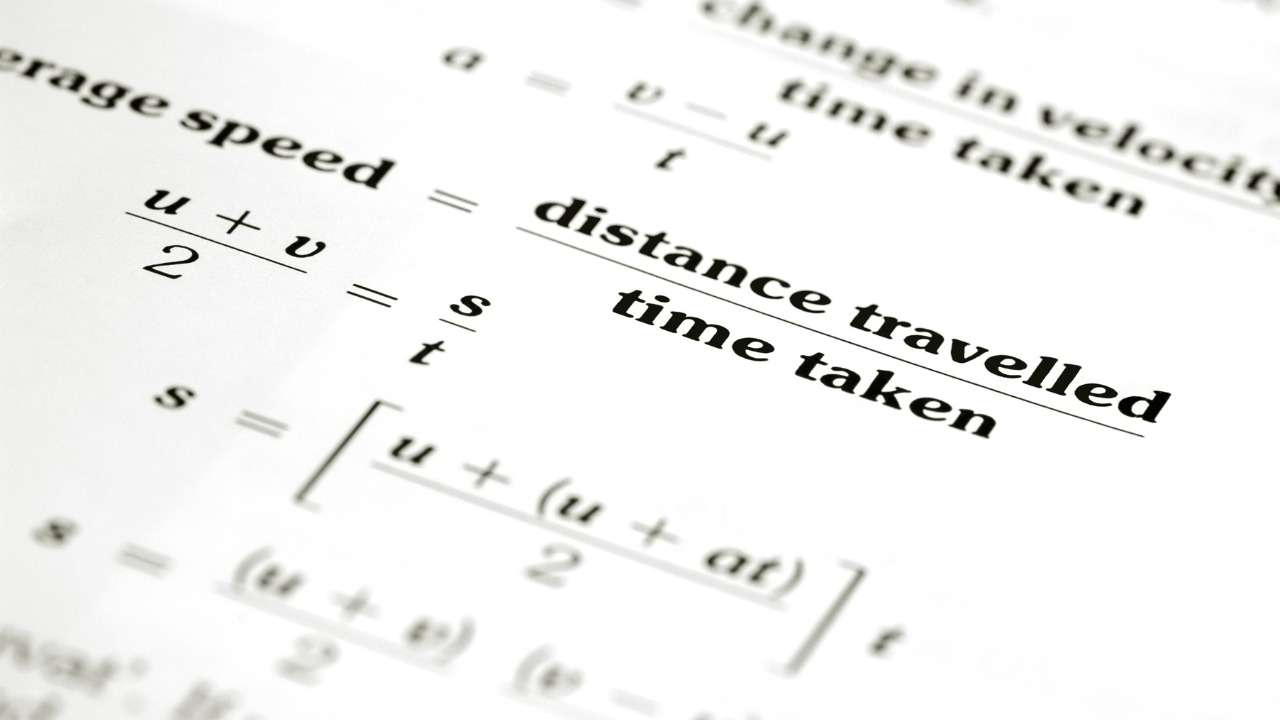
Draw a triangle and split it into three parts, with D at the top and S and T side by side underneath. To find a missing value, cover it with your finger and read what is left:
- Cover S: D sits over T, so Speed = Distance ÷ Time (also written s = d/t).
- Cover D: S and T sit side by side, so Distance = Speed × Time.
- Cover T: D sits over S, so Time = Distance ÷ Speed.
Mathematically, the three variables are linked by one relationship, so knowing any two lets you find the third. You only need to remember one equation, because the other two come from rearranging it.
The triangle is a handy memory tool, but understanding the relationship between the variables keeps you from choosing the wrong operation when a question looks unfamiliar.
Remember that speed calculated using total distance divided by total time gives the average speed over a journey. If an object travels at different speeds, this does not tell you how fast it was moving at every moment.
See how the values change together
When speed remains constant, distance and time are directly proportional. This means that doubling the time doubles the distance travelled, while halving the time halves the distance.
For instance, a walker moving at 5 km/h covers 5 km in one hour and 10 km in two hours.
Spotting this pattern gives you a quick way to check whether an answer is sensible before you hand it in.
Match the Units Before You Calculate
[Note: AI-generated image]
Convert distance units
Mixing units is one of the easiest ways to land on a wrong answer, so match them before you start.
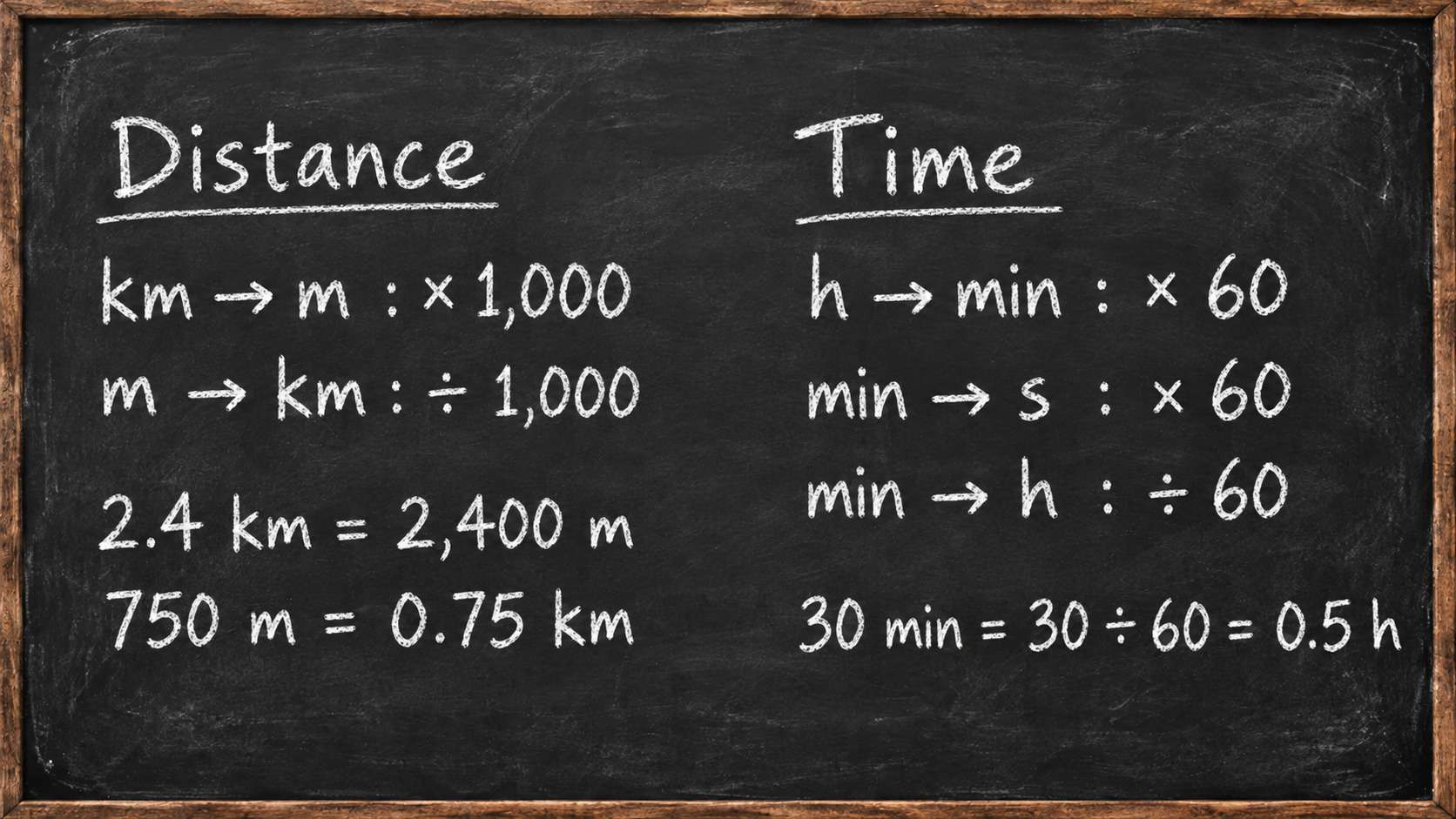
To change kilometres to metres, multiply by 1,000. To change metres to kilometres, divide by 1,000. That makes 2.4 km equal to 2,400 m, and 750 m equal to 0.75 km.
Some questions use centimetres, miles or other units, and the same rules apply: a speed in mph needs a distance in miles, and a speed in cm/s needs a distance in centimetres.
Convert time units
Converting time is where many slips happen, so take it slowly.
To turn hours into minutes, multiply by 60. To turn minutes into seconds, multiply by 60 again.
Going the other way, divide by 60, so 30 minutes becomes 30 ÷ 60 = 0.5 hour.
The unit after “per” tells you which time unit you need: km/h calls for hours, while m/s calls for seconds.
Parent prompt: before any calculating, ask, “Does the distance unit match the speed unit? Does the time unit match the time measurement in the speed unit?”
Circling every unit mentioned in the question first turns this into a habit.
Follow Six Steps for Every Question

A reliable routine takes the guesswork out of word problems. Try to work through these steps in order, every time:
- Identify the unknown. Decide whether you are finding speed, distance or time.
- List the known values. Draw a small table with one row each for S, D and T, and copy in the numbers with their units.
- Convert mismatched units. Standardise minutes and hours, or metres and kilometres, before substituting anything.
- Choose the formula. Use the triangle or the rearranged equation.
- Substitute and solve. Write the formula, then the numbers, then the solution on separate lines.
- Check the answer. Confirm the unit is included, ask whether the result is realistic, and test it with another form of the equation.
Identifying the known values is often the trickiest part because extracting information from a word problem requires reading comprehension as well as mathematical reasoning.
Students need to recognise which details matter, identify the main information and ignore details that do not affect the calculation. These reading skills, alongside a solid understanding of division, fractions and units, help make speed questions easier to solve.
Parent prompt: resist handing over the operation. Ask, “What are we finding?”, “Which two values do we have?” and “Do the units match?” Guided questions build reasoning, not memorisation.
Work Through these Three Solved Examples
Each solved example follows the same pattern: given, formula, working, answer and check.
Example 1: calculate speed
A student walks 1.2 km to the library in 15 minutes. What is the speed in km/h?
- Convert: 15 minutes = 15 ÷ 60 = 0.25 hour
- Formula: Speed = Distance ÷ Time
- Working: 1.2 ÷ 0.25 = 4.8
- Answer: 4.8 km/h
- Check: 4.8 × 0.25 = 1.2 km ✓
Example 2: calculate distance
A cyclist rides at a constant speed of 18 km/h for 40 minutes. How far does she go?
- Convert: 40 minutes = 40/60 = 2/3 hour
- Formula: Distance = Speed × Time
- Working: 18 × 2/3 = 12
- Answer: 12 km
- Check: At 18 km/h, the cyclist would cover 18 km in one hour. Since 40 minutes is two-thirds of an hour, travelling 12 km is reasonable.
A quick estimate like this can catch an unrealistic answer.
Example 3: calculate time
A train covers 150 km at 75 km/h. How long does the journey take?
- Formula: Time = Distance ÷ Speed
- Working: 150 ÷ 75 = 2
- Answer: 2 hours
- Check: 75 × 2 = 150 km ✓
The unit is hours because the speed is in km/h.
Solve Multi-Part Speed Questions
Find average speed
Average speed is calculated by dividing the total distance travelled by the total time taken. When a journey involves different speeds, you must account for how long each part takes rather than simply finding the arithmetic average of the speeds.
Take a car journey in two parts: the first part covers 60 km at 60 km/h, and the second part covers 60 km at 30 km/h.
The first part takes 1 hour and the second takes 2 hours. The total distance is 120 km and the total time is 3 hours, so the average speed is 120 ÷ 3 = 40 km/h.
Notice that (60 + 30) ÷ 2 = 45 km/h is the wrong answer.
The car spends longer at the slower speed, so simply averaging the two speeds does not work.
Handle two moving objects
When two things move towards each other, the gap closes at the sum of their speeds.
Imagine two trains starting 270 km apart and travelling towards each other at 60 km/h and 75 km/h. Together they close the gap at 135 km/h, so they meet after 270 ÷ 135 = 2 hours.
In the same direction, use the difference instead. If a cyclist travelling at 18 km/h follows a friend travelling at 12 km/h in the same direction, the faster cyclist gains 6 km every hour. This means their separation decreases by 6 km per hour. To calculate how long it takes to catch up, you also need to know their initial separation.
Draw a simple line diagram showing the starting positions, direction of travel and distance between the two objects. This makes it easier to decide whether to add or subtract their speeds.
Avoid Common Speed Calculation Mistakes

Even confident students slip on the same few things. Check your work against this list:
- Mixing km with m, or hours with minutes.
- Multiplying when the question asks for speed or time.
- Forgetting to add every part of the journey when finding total distance or total time.
- Averaging two speeds instead of dividing total distance by total time.
- Adding speeds in a same-direction question instead of finding the difference.
- Leaving the unit out of the final answer.
- Assuming an object travels at a constant speed when the question describes changes in speed. In these situations, calculate the distance and time for each part of the journey separately before finding the total or average speed.
Finish with a quick verification routine: reread the question, label your answer with its unit and substitute it into another form of the formula.
If the numbers do not agree, go back to step 3 and check the units first.
Turn Everyday Journeys Into Practice

Formulas feel far more familiar once they leave the worksheet.
Time a short walk to the bus stop or another familiar destination. Measure the distance on a map, then calculate the average speed. You can also compare two routes to the same place and discuss why a longer route can sometimes be quicker.
Before calculating anything, ask your child to estimate how long a cyclist, a car, a train or even a plane would take to reach a destination. Then record the distance and time in a simple table and talk about what happens to one value when the other changes.
Slow things count too. A snail crawling at 3 cm per minute takes 10 minutes to cover 30 cm, and the same formula applies.
Keep practice short and regular: one basic formula question, one conversion question and one word problem make a manageable set of exercises, and they are far easier to stick to than one long worksheet.
Get Help with Speed, Distance and Time at The Nuggets Academy
Regular practice builds familiarity, but multi-step questions sometimes need a patient guide to untangle them.
The Nuggets Academy offers small-group teaching for primary and secondary students, including primary maths classes built on bite-sized, step-by-step lessons with up to six students per tutor.
For children who get easily distracted or find it hard to retain what they have learned, the Brain Train Programme adds 90-minute sessions of research-based brain-development exercises that can be paired with a regular weekly class.
If nerves creep in whenever a word problem appears, read Overcome Math Anxiety: 7 Ways to Build Confidence in Math for practical ways to make maths feel more manageable.
If your child needs additional support with maths, contact The Nuggets Academy to enquire about its current assessment and diagnostic options. The team can discuss your child’s learning needs, identify areas that need attention and recommend a suitable learning plan.