


As a parent in Singapore, you’ve probably seen it before: your child spends hours memorising notes for an exam, only to forget half the information the moment the paper ends. Or maybe they can recite formulas in maths class, but struggle to apply them when faced with problem-solving questions.
This struggle isn’t because your child isn’t smart — it’s about how they’re learning. Traditional rote memorisation may bring short-term results but often fails to build lasting knowledge or true understanding.
That’s where hands-on learning comes in. Also known as learning by doing or experiential learning, this approach allows students to actively engage in lessons. Instead of passively memorising, children experience concepts directly, which helps them retain knowledge and apply it in real-world situations.
In this article, we’ll explore what hands-on learning is, why it’s often more effective than rote memorisation, six key benefits, practical examples in science and maths, and why it matters in today’s education landscape.
Keep reading to discover how hands-on learning can transform your child’s education — and why it may be the missing piece in their academic journey!
What is hands-on learning?

At its core, hands-on learning is an approach where students actively engage in tasks, activities, or projects instead of passively listening or memorising.
Educational pioneers like Maria Montessori and David Kolb highlighted that children learn best when they explore, experiment, and apply ideas in supportive environments.
For example, instead of only reading about a science experiment, your child might actually mix vinegar and baking soda to watch the reaction. In maths, rather than memorising formulas, they could measure the angles of their school playground.
Hands-on learning allows learners to see, touch, and try for themselves — making the learning experience richer, more engaging, and easier to remember.
6 benefits of hands-on learning

We’ve seen how hands-on learning compares to rote memorisation, but what makes it so powerful in practice? The answer lies in the real advantages children gain when they actively learn.
Here are six benefits that can transform your child’s education and future:
1. Builds critical thinking and problem-solving skills
When children are actively engaged, they naturally ask questions like “Why did this happen?” or “How can I solve this differently?”. These questions spark deeper thinking.
For example, a science experiment that fails encourages them to re-examine their steps and consider alternative methods. This turns mistakes into opportunities for learning.
Problem-solving in hands-on activities also builds persistence. Children learn that challenges can be broken down into smaller steps.
Over time, this mindset helps them tackle not only academic problems but also real-world challenges with confidence.
2. Improves memory retention
Children remember experiences more vividly than words on a page. Hands-on learning strengthens brain connections, making knowledge stick.
When they measure, observe, or test something themselves, they create lasting “mental anchors” for information. This goes beyond short-term cramming.
For instance, mixing vinegar and baking soda makes the concept of chemical reactions unforgettable. A textbook explanation alone won’t have the same effect.
This lasting memory means your child can recall and apply what they’ve learnt more easily during exams — and later in life.
3. Develops motor skills and social skills
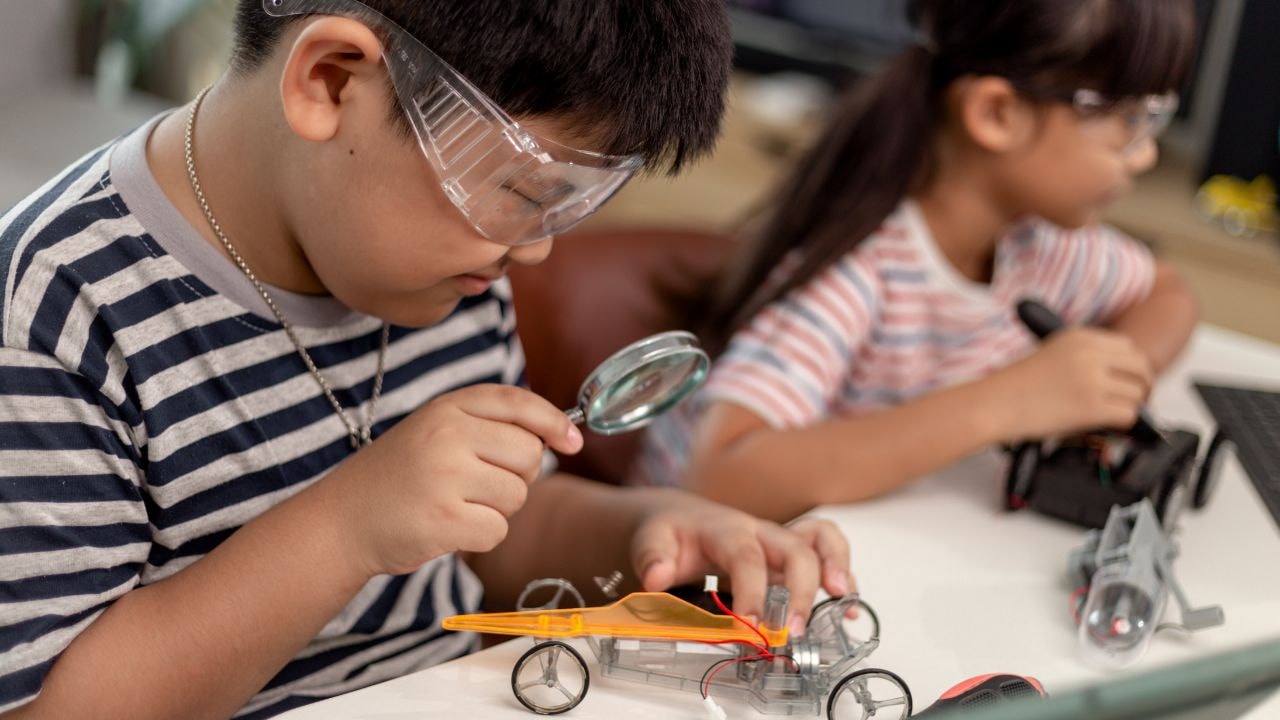
Hands-on learning often involves movement: cutting, measuring, building, or writing. These activities refine motor coordination while reinforcing concepts.
It also encourages collaboration. Working in pairs or groups helps children practise listening, sharing ideas, and cooperating.
Group projects naturally teach leadership and teamwork. Each child contributes, whether by organising, presenting, or problem-solving together.
These social skills are not just useful in school; they’re lifelong tools for communication and collaboration in any setting.
4. Provides real-world application
Many children wonder, “When will I ever use this?”. Hands-on learning provides the answer by connecting lessons to daily life.
Cooking becomes a maths exercise in measurements. Planting seeds teaches biology concepts like growth and sunlight.
By applying theory to real-world tasks, children see immediate relevance in what they learn. This increases motivation and interest in the subject.
It also shows them that knowledge isn’t confined to the classroom; it’s a tool for solving everyday problems.
5. Encourages creativity and innovation
Experimenting gives children permission to think outside the box. They learn that there’s often more than one way to reach a solution.
Hands-on projects allow them to test ideas, take risks, and refine their approaches. This builds resilience and flexibility.
When children are encouraged to innovate, they feel a sense of ownership in their learning. That ownership drives confidence.
Ultimately, they become more willing to tackle unfamiliar challenges creatively — an essential skill for the future.
6. Creates deeper subject understanding
Memorisation answers the “What,” but hands-on learning digs into the “Why” and “How.” This creates real comprehension.
For instance, calculating angles on paper teaches the formula. However, measuring playground structures shows how geometry applies outside exams.
This approach connects abstract theory with tangible reality, therefore deepening understanding. Children can then transfer knowledge to new situations.
A deeper grasp of concepts also makes exam prep less about cramming and more about applying what they already know.
Hands-on learning isn’t just engaging; it transforms how children think, remember, and apply knowledge.
But how does this approach actually play out in the classroom? Let’s look at some practical examples in science and maths.
Examples of hands-on activities in science and maths

Parents often wonder: What does hands-on learning in science or maths look like? Here are some examples you might want to try with your child:
Science experiments
Students can build simple circuits to learn how electricity flows, or test how plants grow under different light conditions. These quick experiments make theories tangible.
Maths applications
Children might calculate area using measuring tapes, plan a budget for a “mock supermarket trip” or build paper structures to explore geometry. Each activity links maths to daily life.
Project-based learning
Group projects, such as finding ways to reduce waste in school, combine science, maths, and teamwork. They show how knowledge applies to real-world challenges.
These activities prove that learning isn’t limited to textbooks. And that’s why hands-on learning is more important than ever in today’s education system.
Why hands-on learning is essential in education today

The examples we’ve seen aren’t just fun activities — they highlight why hands-on learning is so important in Singapore’s fast-paced, exam-driven system.
It prepares children for real-world situations beyond school, giving them practical skills they can use later in life.
It nurtures curiosity and builds confidence, helping them approach challenges with resilience instead of fear.
It reduces reliance on last-minute cramming by creating stronger foundations that last well beyond exams.
And perhaps most importantly, it makes learning more enjoyable — which motivates children to stay engaged and keep improving.
The importance of learning by doing method cannot be overstated. That’s why we’ve made it a cornerstone of what we offer at The Nuggets Academy.
Let your child learn by doing and grow with confidence at The Nuggets Academy

Many children can memorise notes but struggle to apply concepts or remember them beyond exams.
That’s why hands-on learning matters — it turns abstract ideas into real understanding. At The Nuggets Academy, we make this approach a core part of our teaching. Your child will learn to connect lessons to real life, not just cram for short-term results.
Building lasting knowledge also means working closely with families. Strong parent-teacher communication makes a big difference in how children learn — discover our tips here: Parent-Teacher Communication: 6 Tips for Meaningful Communication.
They’ll also build confidence, creativity, and problem-solving skills that serve them well in exams and beyond. With our guidance, students develop lasting knowledge while still achieving strong academic performance.
WhatsApp us today to book a trial class and give your child the gift of learning by doing!