


Results day can feel as though the whole year has been building up to one envelope.
If your child’s PSLE results are lower than expected, however, that does not necessarily mean they have “failed” PSLE.
Under Singapore’s current Achievement Level (AL) scoring system, there is no official pass or fail grade for individual PSLE subjects. Most students are assessed as suitable for secondary school and progress through one of the three Posting Groups.
For the small minority who are not assessed as suitable for secondary school, there are still options.
Students may re-attempt the PSLE the following year or apply to specialised schools such as Assumption Pathway School and NorthLight School, subject to the relevant requirements.
This guide explains what a low PSLE score actually means, how PSLE results affect secondary school posting, what happens if a child is not assessed as suitable for secondary school, and what parents can consider next.
Understanding the PSLE Scoring System
PSLE is used for secondary school posting
The Primary School Leaving Examination (PSLE) is a national exam taken by Primary 6 students at the end of primary school. Its results help determine which secondary school options and Posting Groups are available to each child.
Under the current Achievement Level (AL) system, there is no official pass or fail grade for individual PSLE subjects. Instead, each subject is assigned an Achievement Level based on the child’s marks.
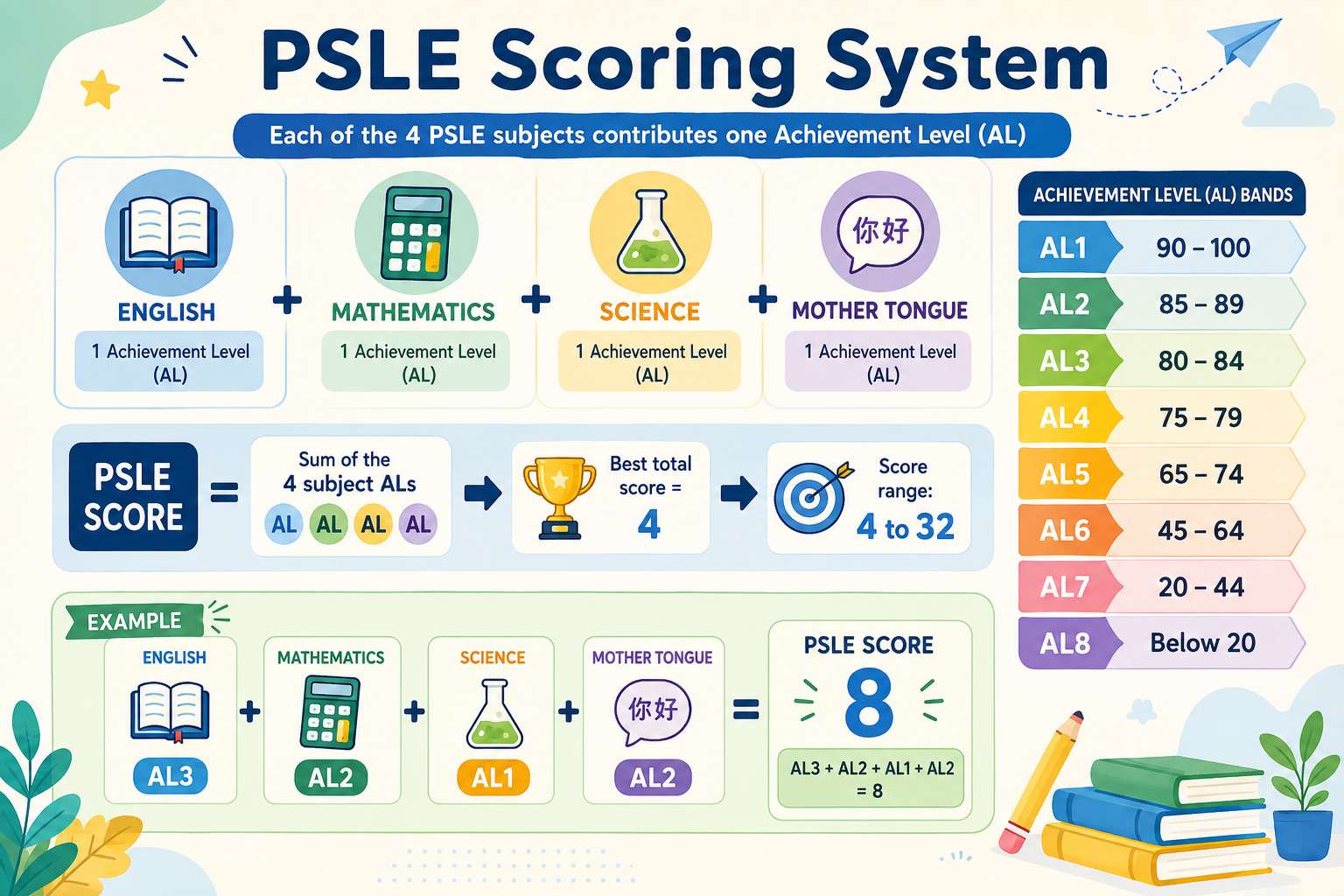
How the new PSLE scoring system works
Each of the four PSLE subjects — English, Mathematics, Science, and Mother Tongue — is graded separately using Achievement Levels, from AL1 (90–100 marks) to AL8 (below 20 marks).
Your child’s PSLE score is the sum of these four subjects’ ALs. This means the total scores range from 4 (best) to 32 (lowest), with a lower number indicating a stronger result.
This current AL system replaced the previous PSLE T-score aggregate in 2021. Rather than comparing students’ performance against the rest of the cohort, the AL system groups marks into broader bands of achievement.
This also means that a weak result in one subject is reflected through that subject’s AL rather than through a T-score calculated relative to the cohort.
For example, under the old T-score system, performing poorly in Math could sharply drag down a child’s aggregate score. Today, the same weak performance is reflected as a higher AL for Math, which contributes to a higher total PSLE Score.
Want to know more? Read our PSLE AL Score: Understanding the New System Five Years On for a better understanding!
How PSLE scores link to secondary school posting and Full SBB
From the 2024 Secondary 1 cohort onwards, the old Normal (Academic), Normal (Technical) and Express streams have been replaced by Full Subject-Based Banding (Full SBB).
Students are now posted to secondary schools through Posting Groups 1, 2 and 3, based on their eligibility:
| PSLE Score | Posting Group | Indicative Level for Most Subjects |
|---|---|---|
| 4–20 | 3 | G3 |
| 21–22 | 2 or 3 | G2 or G3 |
| 23–24 | 2 | G2 |
| 25 | 1 or 2 | G1 or G2 |
| 26–30, with AL7 or better in English and Mathematics | 1 | G1 |
Under Full SBB, your child isn’t locked into one difficulty level across every subject.
For example, a PG2 student who scored AL5 or better in PSLE Science may be eligible to take Secondary 1 Science at G3, even though most of their subjects are at G2.
To know more about SBB, read our article: Subject-Based Banding (SBB): How MOE’s New System Will Affect Your Child in Secondary School!
What Does a “Failed” PSLE Result Really Mean?
One weak subject versus your child’s overall score
In general, there is no way for a child to have “failed PSLE”. While your child may score lower than expected, they are still able to progress to secondary school!
Officially, secondary school posting depends on the total PSLE Score and the minimum requirements in key subjects.
For most Posting Group eligibility, the overall PSLE Score is the key factor, although certain subject-level requirements also apply.
For example, students with a PSLE Score of 26–30 need AL7 or better in both English Language and Mathematics to be eligible for Posting Group 1.
That said, a failed Math result can dent a child’s confidence heading into Secondary 1 Mathematics, which is why targeted support in the months after PSLE matters more than the score itself.
When results affect mainstream secondary school posting
For most students, PSLE results open up a range of mainstream secondary school options.
Only a small minority may not meet the criteria for mainstream posting — official 2025 figures from the Singapore Examinations and Assessment Board (SEAB) show that 98.5% of the students who sat the PSLE that year were assessed as suitable for secondary school, a rate that’s held steady for years.
Students who score above 30 points, or who don’t achieve at least AL7 in English and Mathematics, may be offered alternative pathways rather than standard mainstream posting.
This small remaining group may re-attempt the PSLE the following year, or apply to specialised schools with their principal’s recommendation.
Secondary School Pathways After PSLE
Mainstream schools and posting groups
For most students, PSLE results help determine which Posting Group they are eligible for and which secondary school choices are realistic.
Students enter secondary school through Posting Groups 1, 2 or 3, with their initial subject levels set at G1, G2 or G3.
Under Full Subject-Based Banding (Full SBB), students can take different subjects at different levels based on their strengths, learning needs and subject-specific eligibility.
Students with strong PSLE results may also apply to Integrated Programme (IP) schools. These schools offer a six-year secondary-to-pre-university pathway without requiring students to sit for the Singapore-Cambridge Secondary Education Certificate (SEC) midway through the programme. Depending on the school, students may eventually graduate with an A-Level, IB Diploma or NUS High School Diploma.
For students in the mainstream secondary school system, the SEC will replace the existing N- and O-Level examinations from 2027.
Specialised schools and alternative pathways
NorthLight School and Assumption Pathway School are examples of specialised schools for students who don’t qualify for mainstream secondary posting after PSLE.
Both offer a more hands-on, skills-focused curriculum that builds on literacy, numeracy, and life skills.
Many graduates progress to the Institute of Technical Education (ITE) and further vocational training, and plenty build successful careers from there.
Although this pathway differs from a traditional one, it is by no means less valuable.
Choosing the right school environment
Whichever pathway your child is on, it’s worth looking past cut-off points and rankings.
Consider the school’s distinctive programmes, overall environment, culture, and support system — including provisions for special educational needs, where relevant.
A school that matches your child’s temperament and needs, where teachers are supportive, and the pace is suitable, will do more for long-term development than one chosen purely for prestige or reputation.
This is particularly relevant if your child had a difficult PSLE experience and needs an environment that helps rebuild confidence.
Practical Next Steps for Parents On Results Day

How to respond in that first conversation
How parents respond in the hours right after the results come out often matters more than the score itself.
A few things will genuinely help reduce panic, both for you and your child:
- Process your own reaction before talking it through with your child, so you can lead with reassurance.
- Listen before offering solutions — children often remember how a conversation made them feel more than what was said.
- Avoid comparing results with siblings, cousins, or classmates, as it can deepen feelings of inadequacy.
- Separate the score from your child’s identity. One exam result doesn’t define their ability or future.
Communicate with teachers
Once the initial reaction has settled, take time to read the posting outcome and PSLE score properly, rather than relying on rumours circulating among other parents.
Your child’s primary school teachers, who know their learning profile well, are usually the best first stop for questions about realistic school choices and whether specialised schools are worth exploring.
In the Secondary 1 posting exercise, school choices are ranked against the PSLE score and standard tie-breakers; if a child doesn’t get any of their six choices, MOE will still assign a school with places available within their eligible Posting Group.
Supporting Your Child’s Learning After A Low PSLE Result

Rebuilding confidence at home
Emotional support is just as important as academic planning in the weeks that follow.
Simple, steady routines, such as pursuing hobbies, getting proper rest, and open, non-judgemental check-ins, can help a child regain control faster than a sudden, high-pressure push.
Also, remind your child that PSLE does not decide their entire life; secondary school and other checkpoints will give them more opportunities to grow!
Strengthening the weak foundations in key subjects
Where results were disappointing, it’s worth identifying the root cause rather than assuming a lack of effort. Oftentimes, it comes down to weak foundations in specific topics rather than the subject as a whole.
By pinpointing the root cause, you can build a realistic action plan and help your child make headway with focused practice on the exact problem areas.
This is where structured support helps: a primary maths programme built around a child’s specific gaps can rebuild fundamentals, while a problem sums masterclass suits students who grasp basic concepts but struggle once questions get complex.
For children whose confidence and focus took a big hit, a Brain Train programme can strengthen concentration and thinking skills that support learning more broadly.
Retaking the PSLE

Who can retake, and how it works
Students who don’t qualify for mainstream secondary school postings generally have a choice:
- Retake the PSLE for an additional year to improve their scores by repeating Primary 6, or
- Move ahead into a specialised school with a principal’s recommendation
Deciding if a retake year is the right call
Retaking isn’t automatically the “better” option, and it may not be right for every child.
Weigh your child’s emotional readiness, whether there are clear learning gaps a focused year could realistically close, and whether your family can sustain genuine support through another exam year.
Beware that retaking PSLE involves another full year of exam-focused preparation and should be considered carefully.
Make this decision with your child’s teachers and your child, and not by comparing your child to other students’ PSLE results.
Encourage Your Child to Move Forward Confidently
Whatever the PSLE score turns out to be, it’s not a summary of who your child is or will become. This is only one chapter with many more yet to come.
Here are a few reminders to help families keep that perspective in the weeks after results:
- Treat the result as information for planning.
- Keep comparisons with siblings or classmates out of the conversation.
- Build an encouraging support system around your child.
- Give credit for effort and progress.
Many students who start secondary school in a Normal-equivalent or technical stream go on to thrive and build successful careers later on.
Secondary school also brings its own rhythm of school-based assessments — our guide to Weighted Assessment Singapore: What Parents and Students Should Know is a useful next read to understand how ongoing assessment will work from here.
Take the Next Step with The Nuggets Academy
Transitioning from PSLE to secondary school is a big change, especially if your child’s results were lower than expected.
To make this next stage more manageable, many families choose structured academic support that focuses on rebuilding foundations, strengthening thinking skills, and restoring confidence.
The Nuggets Academy is one such learning partner that specialises in helping primary and lower-secondary students make this shift more smoothly.
Our programmes cover primary English and primary science alongside targeted maths support, so you can address more than one weak subject without looking for a separate place.
Remember, a low score does not indicate failure, but is a starting point for a plan for your child’s future. Contact Us now to find a class that fits them!